

What if your cloud issues could tell you exactly why they happened before your users complained?
Most teams are nowhere close to that reality. They spend hours switching between dashboards. They chase alerts that reveal nothing about the real problem. They fix incidents only to watch them return to another part of the system. And the biggest pain point is that they are always reacting instead of understanding.
This is where cloud observability becomes non-negotiable.
Modern cloud environments are too distributed, too fast-moving, and too business-critical for traditional monitoring. Leaders want fewer outages. Teams want faster root-cause analysis.
CFOs want predictable cloud costs. None of this is possible without deeper visibility into how their systems behave.
In this blog, we will unpack what cloud observability truly means, how it goes beyond monitoring, and why it is now the foundation for cloud reliability, performance, and smarter decision-making. Let’s break down the why and what of cloud observability.
What Is Cloud Observability and How Is It Different from Monitoring?
Most teams believe they already have visibility because they have monitoring. But monitoring only tells you what broke. It rarely tells you why.
Cloud observability changes that.
Monitoring relies on predefined dashboards, fixed alerts, and known failure patterns. It works only when you already understand how your system behaves. In a modern cloud environment filled with microservices, APIs, containers, serverless functions, and constant deployments, this approach is not enough. The problems you face tomorrow may look like the problems you saw last month.
Cloud observability gives you the ability to ask new questions without having to instrument new dashboards. It helps you understand relationships across logs, metrics, and traces. It uncovers hidden dependencies. It connects the dots between symptoms and the actual root cause.
This is the difference that matters. Monitoring watches. Observability explains.
Multi-cloud set ups, regular releases, and performance problems that are hard to predict and emerge unannounced now make observability a necessity for businesses dealing with unpredictable workloads, a reality that well-structured cloud engineering services help address through better visibility and system reliability. It also is the only means of knowing how your system operates not only on the surface but also internally.
With this foundation clear, let’s move deeper into the components that make observability truly powerful.
What Are the Core Components of an Effective Cloud Observability Strategy?
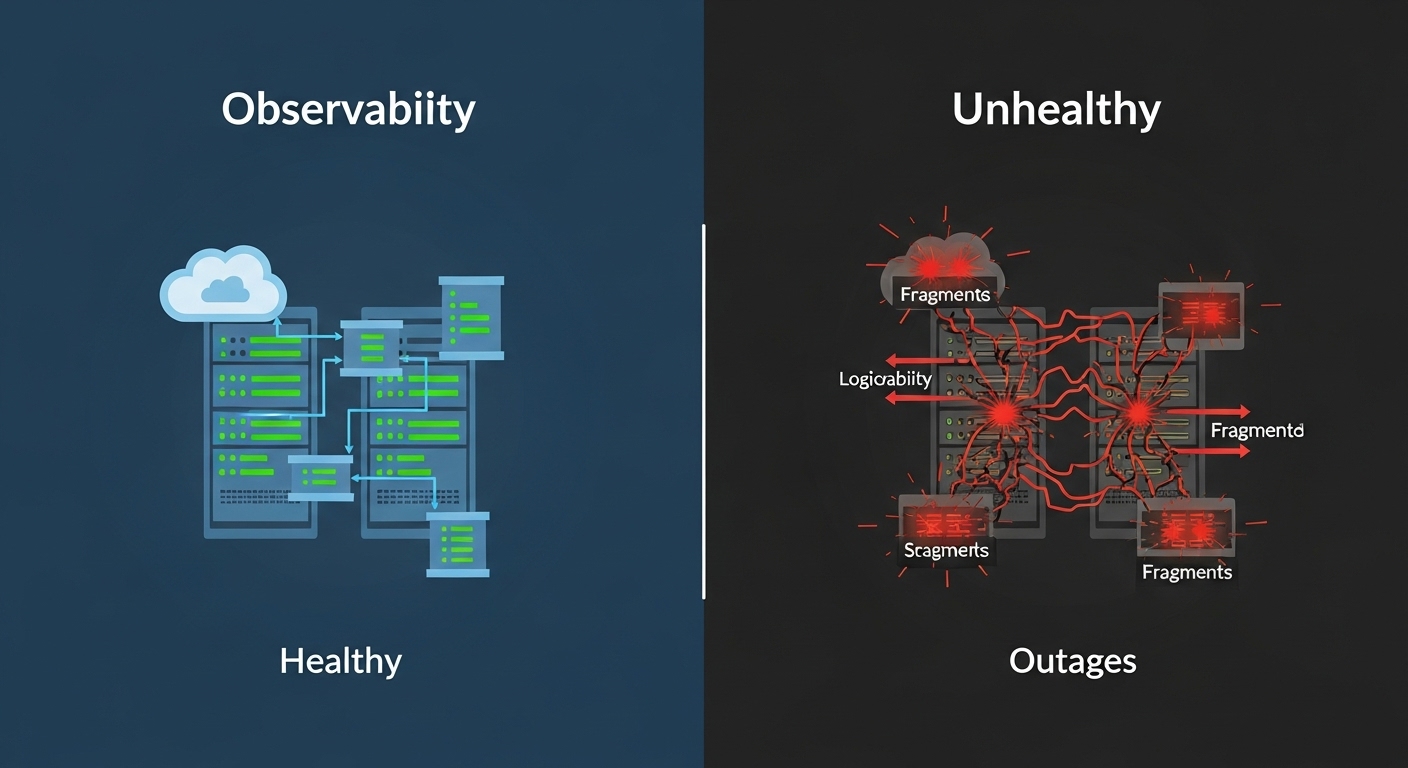
If cloud incidents feel unpredictable, it is usually because teams are looking at fragments instead of the full picture. An effective cloud observability setup fixes that by connecting every signal your system produces into one unified story.
Here are the core components that make this possible.
Logs
Logs give you the raw truth of what happened inside your system. They help you validate events, spot anomalies, and trace unexpected behavior. Without clean, structured logs, troubleshooting becomes guesswork.
Metrics
Metrics track the health of your cloud environment in real time. CPU spikes, latency trends, memory leaks, request rates, or throughput patterns. It is the fastest way to know something is off before users notice.
Traces
In a world of microservices, tracing is the glue. It shows how a single request travels across multiple services. It reveals bottlenecks, broken dependencies, and exactly where a failure starts.
These three pillars work best when they are connected. Observability is not about collecting more data. It is about correlating the right data at the right time.
Event Correlation and Context
When an issue hits production, you do not need 200 alerts. You need clarity. Event correlation ties logs, metrics, and traces together so teams can see the entire chain of events in seconds.
AIOps and Automation
The new observability platforms apply AI to unveil patterns missed by humans. Automated RCA, noise reduction, anomaly detection, and intelligent alerting assist the teams in changing their operations to predictive mode.
When these elements come to play, you have left firefighting and begun to comprehend. You end up being a guesser and begin to optimize. This is the way observability can be a strategic asset, not a technical tool.
It is time to move to the direct benefits of building blocks, which can increase cloud performance and reliability.
How Does Observability Improve Cloud Performance and Reliability?
Enterprises usually struggle with the same recurring issues. Slow applications that users complain about before teams even notice. Incidents that take hours to diagnose because no one knows where the problem actually started. Costs rise without a clear explanation. These are not technical gaps. These are visibility gaps.
Cloud observability solves them by giving teams the context they never had.
Faster Incident Detection
When your system can highlight anomalies the moment they occur; you cut down the time spent searching for the problem. Teams see the deviation instantly instead of waiting for a downstream failure.
Better Root-Cause Analysis
Traces, logs, and metrics come together to reveal the exact service, function, or dependency that triggered the issue. You stop fixing symptoms and start fixing the source.
ReducedMTTR
The biggest win is time. Observability reduces the need for war rooms, guesswork, and escalations. Faster RCA means faster recovery, which means fewer business disruptions.
Better Application Performance
End-to-end visibility assists the teams to determine the flow of each request across the cloud environment. You are aware of slow services, overloaded nodes, hotspots in latency, and performance regressions even before users experience them.
Improved Cloud Reliability
Observability is capable of assisting DevOps, SRE, and platform teams by providing real-time insights. You are able to verify deployments, gauge the health of the service, and identify patterns that usually result in outages.
Smarter Cost Optimization
Unknown behaviors are the usual causes of unexpected cloud bills. Observability brings light inefficient services, workloads that are noisy, and unneeded resource use such that teams can make right-sizing before costs start to skyrocket.
When observability becomes part of daily operations, performance stops being a moving target. Reliability becomes predictable. Teams gain the confidence to ship faster without fearing hidden failures.
With the impact clear, let’s move to how organizations can build a culture that supports observability at scale.
What Does It Take to Build an Observability-First Culture in the Cloud?
Most observability failures are not tool failures. They are culture failures. Teams invest in platforms, dashboards, and agents, but the real challenge is getting people to use observability as a daily habit instead of a last-minute rescue.
Building an observability-first culture starts with how teams think, not what they deploy.
Shift From “Fixing Issues” to “Understanding Systems”
Teams need to move beyond reacting to alerts. They must focus on understanding system behavior, performance patterns, and the dependencies behind every service. This mindset shift is what transforms observability from a tool into an operational backbone.
Developer Ownership
Observability is most effective when engineers own their code in production. This means instrumenting services, tracking performance, reviewing logs, and validating deployments. It ensures issues are caught early, and RCA becomes faster.
Shift-Left Practices
Early implementation of observability in the development process assists the teams in uncovering anomalies before they can reach the production process. The pre-deployment tests, trace checks, and local performance reviews minimize the unexpected after release.
Indication of clear Dashboards and Smart Alerts.
The number of dashboards among teams is very high, yet not many of them are value-adding. An observability-first culture makes insights uncomplicated. There are meaningful alerts, little noise, and the dashboards are based on business-impact numbers as opposed to vanity numbers.
Governance and Data Hygiene
Businesses tend to gather unorganized data in a large amount. An effective observability culture must have clean logs, standardized metrics, consistent tagging, and high access control. Discipline brings clarity.
Cross-Team Collaboration
The work of SRE, DevOps, platform engineering, and development teams has to be conducted under one visibility. Noticeability is the lingo. People all view the same truth, make quicker decisions, and solve problems without finger pointing.
Upon the introduction of observability into the culture, teams work at a greater pace with fewer errors. Reliability improves. Deployments become foreseeable. And the cloud ceases into a black box. Now, let’s look at how real-world companies are using observability to get measurable results.
What are Some Real-World Examples of Cloud Observability Driving Success?
Below are some short and popular examples showing how observability turned guesswork into predictable outcomes.
Netflix — built observability into the platform
Netflix Invested in observability tooling (logs, metrics, tracing, stream processing) to troubleshoot distribution, global systems, and shorten the time to diagnose complicated problems. Their engineering posts describe how an observability-first approach enables teams to find root cause at a faster pace and scale.
Uber — invented Jaeger and open-sourced tracing tools
Uber created Jaeger for distributed tracing and published work on M3 (metrics) and sampling strategies. Those tools let engineers trace requests across services, pinpoint causation, and reduce time spent chasing symptoms. Jaeger later joined CNCF and is widely used across the industry.
Shopify — moved to a planet-scale, cost-aware observability stack
Shopify documented rebuilding parts of its observability stack in-house to handle massive data volumes and to control rising third-party costs. The result: better query performance and substantially lower ingestion/storage costs — an example of observability directly impacting both reliability and cloud spend.
Airbnb — centralized observability to keep services reliable as they scaled
Airbnb’s engineering teams created observability tooling and practices (tracing, centralized logs, dashboards) so engineers could develop and operate services with confidence at large scale. Their talks and case materials show observability reduced firefights and helped maintain platform reliability during rapid growth.
Conclusion
To achieve cloud success in the contemporary world, it is not about monitoring but knowing your systems. Observability provides context to the teams so that they can identify problems early and locate the root cause of problems faster and maintain predictable performance despite increasingly complex environments. It will eliminate guesswork and transform signals into actual knowledge that leads to making superior judgments.
Observability is no longer a choice in enterprises seeking to grow with certainty. It enhances reliability, better user experience, and reinstates control to teams that tend to be in reactive mode. Limit scope initially, gain visibility gradually, and allow observability to be the base of a more resilient and future-resistant cloud environment.
